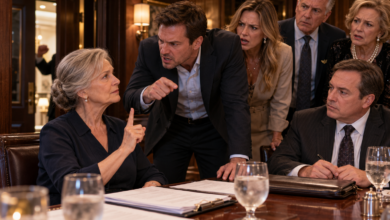
HOURS AFTER I GAVE BIRTH TO TRIPLETS, MY FATHER TRIED TO GIVE ONE OF MY BABIES TO MY BROTHER
PART 3
The door opened less than twenty seconds after I pressed the button.
Two nurses entered first.
Then a security officer.




My father was still holding Grace.
One nurse, Caroline, immediately stepped between us.
“Sir, place the infant back in the bassinet.”
Richard scoffed.
“This is a family matter.”
“No,” Caroline said calmly. “That is a hospitalized newborn.”
Her tone changed the room.
Daniel finally moved.
“Dad, just give her back.”
My father glared at him.
“You wanted this child too.”
Daniel’s face went white.
Jessica whispered, “Richard, stop.”
Caroline held out her arms.
“Sir. Now.”
My father surrendered Grace.
The moment Caroline placed my daughter against my chest, I started shaking.
Not crying.
Shaking.
I pressed my cheek against her tiny head.
She was safe.
That was all I cared about for those first few seconds.
Then the second security officer entered.
Caroline looked at the swelling beginning near my temple.
“Did someone strike you?”
My mother answered before I could.
“It was an accident.”
I looked directly at her.
“No.”
Her mouth closed.
“My father hit me while I was trying to stop him from taking my baby.”
Everything changed after that sentence.
Security removed my family from the room.
Jessica started protesting.
My father threatened lawsuits.
My mother cried.
Daniel kept saying, “This got out of hand.”
But nobody was allowed back inside.
A doctor examined me.
Fortunately, the blow had not caused a serious injury.
Grace was also checked.
She was unharmed.
Then Caroline sat beside my bed.
“I need to ask you something.”
Her expression was strange.
Not frightened.
Concerned.
“Do you know whether your sister-in-law contacted this hospital before today?”
I stared at her.
“What?”
Caroline glanced toward the door.
“About three months ago, someone named Jessica Vance called maternity administration several times.”
My stomach tightened.
“Why?”
“She asked questions about infant discharge procedures.”
I couldn’t speak.
Caroline continued carefully.
“She wanted to know whether a newborn could leave with someone other than the birth mother if certain authorization forms were signed.”
The room seemed to tilt.
“That doesn’t make sense.”
“I hope it doesn’t.”
Then she added:
“She also asked whether a baby could be added temporarily to another family member’s insurance before formal guardianship was completed.”
My hands became cold.
I looked at Grace.
Then Noah.
Then Sophie.
This wasn’t an emotional outburst.
This had been research.
Planning.
Preparation.
Hospital administration contacted the police.
Because my father had tried to leave the room with Grace after I explicitly told him not to, and because he had struck me when I intervened, the hospital treated the incident seriously.
An officer took my statement.
Then they began interviewing my family separately.
That was when their story started collapsing.
My mother claimed the idea had only been “discussed casually.”
Jessica said Richard had pushed everyone into it.
Richard insisted I had promised months earlier that Daniel and Jessica could “have one” if all three babies survived.
That was a lie.
Then Daniel said something none of them expected.
“I never believed Maya agreed.”
The officer looked at him.
“What does that mean?”
Daniel rubbed both hands over his face.
For the first time, he looked less like my father’s obedient son and more like a frightened man realizing how far things had gone.
“Dad said she would.”
Jessica stared at him.
“You knew?”
“I knew Dad was talking about it. I didn’t know about the hospital calls.”
“You absolutely knew,” she snapped.
Their marriage began unraveling right there in the interview room.
By the time David reached the hospital that afternoon, police had already found more.
He entered my room still wearing the clothes he had traveled in.
His face crumpled when he saw me holding Grace.
He crossed the room without speaking and wrapped one arm around me while touching each baby gently with the other.
“I’m sorry,” he whispered.
“For what?”
“For leaving.”
“You went to work.”
“I should have been here.”
I shook my head.
“This isn’t your fault.”
Then the officer returned carrying copies of several documents.
One was a draft guardianship agreement.
My name appeared at the bottom.
Or something resembling my name.
David took one look at the attorney’s letterhead.
His expression changed.
“I know this firm.”
I stared at him.
“How?”
“Your father asked me about them.”
My stomach dropped.
“When?”
“Four months ago.”
David explained.
Richard had called him claiming Daniel and Jessica were considering adoption and asked whether David knew any reputable family-law attorneys.
David had assumed they were exploring legitimate adoption.
He had recommended a firm used by someone at his company.
My father had taken that recommendation and apparently used it to begin building an entirely different plan.
The attorney had never been told the truth.
According to the records investigators later obtained, Richard had represented the situation as a voluntary intra-family placement.
He claimed I was overwhelmed by triplets and had already agreed that Daniel and Jessica would raise one child.
He even submitted preliminary information using my full legal name.
Then came the forged authorization.
It wasn’t sophisticated.
But it was close enough that someone hoped it might move paperwork forward before I realized what was happening.
My mother admitted she knew about the meetings.
Jessica admitted she had attended one.
Daniel claimed he had avoided them because the entire idea “felt wrong.”
That confession destroyed whatever remained between him and Jessica.
But the hardest part for me wasn’t the paperwork.
It was asking my mother one question.
“You knew?”
She cried immediately.
“Maya—”
“You knew they were planning to take one of my babies?”
“We thought…”
She covered her mouth.
I waited.
“We thought three would be too much for you.”
I stared at her.
“And you thought that gave you the right to choose which child I lost?”
She shook her head frantically.
“We weren’t taking a child. Daniel would still be family.”
That sentence told me everything.
To them, motherhood was interchangeable.
Blood made ownership negotiable.
And because Daniel had suffered infertility, they had convinced themselves that my pregnancy created an obligation.
I looked at my mother.
“You didn’t call an ambulance for me.”
She froze.
“When I went into labor, I begged you to come.”
“Maya…”
“You told me to call 911.”
Her face collapsed.
“And now I understand why.”
David looked at me.
I could barely get the words out.
“You were waiting for me to deliver without David here.”
Silence.
My mother started sobbing.
That silence was enough.
They had expected me to be exhausted.
Medicated.
Alone.
They thought grief, pressure, and confusion might do the rest.
They were wrong.
The hospital issued a strict no-contact order for my room.
My parents, Daniel, and Jessica were removed from the maternity floor.
I stayed another four days while the babies gained strength.
David never left except to shower.
He slept folded into an awful hospital chair with one hand touching the side of my bed.
When we finally brought our children home, we changed the locks before we arrived.
We installed cameras.
We contacted an attorney.
And for several months, my parents had no contact with us.
My father faced legal consequences for striking me and for the attempt to remove Grace against my wishes.
The document issue became a separate matter.
I won’t pretend it ended with some dramatic courtroom speech.
Real consequences are usually slower.
Paperwork.
Hearings.
Lawyers.
Statements.
But for the first time in his life, my father could not bully everyone into accepting his version of events.
My mother eventually wrote me a sixteen-page letter.
I read it once.
Then put it away.
She apologized.
But apologies do not restore trust automatically.
Daniel filed for divorce from Jessica eight months later.
One evening, almost a year after the birth, he called me.
I almost didn’t answer.
“I should have stopped Dad months earlier,” he said.
“Yes.”
“I kept telling myself it was just talk.”
“Yes.”
His voice broke.
“I’m sorry.”
I didn’t tell him everything was okay.
It wasn’t.
But I told him the truth.
“If you want a relationship with me someday, start by becoming someone my children never need protection from.”
He said he understood.
And slowly, over time, he tried.
Not with gifts.
Not with dramatic speeches.
With consistency.
Respect.
Boundaries.
Our triplets turned two last spring.
Noah is fearless.
Sophie sings to herself whenever she’s sleepy.
And Grace—the baby my father once carried toward that hospital door—has the loudest laugh of all three.
Sometimes I still think about that red emergency button.
Such a small thing.
A square of plastic beside my hospital bed.
I had felt weak that day.
Exhausted.
Cut open.
Outnumbered.
But strength doesn’t always look like standing up and fighting.
Sometimes strength is knowing you don’t have to fight alone.
Sometimes it is pressing one button.
Calling one nurse.
Telling one person the truth.
And refusing to let people disguise control as love.
My father said I had three children as though having more meant any one of them mattered less.
He was wrong.
Love doesn’t divide that way.
A child is not an extra.
Not compensation for someone else’s pain.
Not a gift adults can exchange to make life feel “fair.”
Each of my babies came into this world as their own person.
And from the moment I first heard their three tiny cries, there was never a spare one among them.