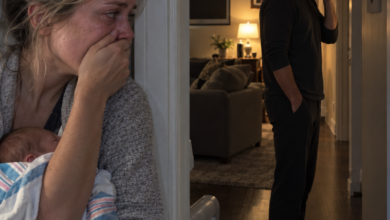
My 10-Year-Old Daughter’s Pregnancy Test Was Positive — Her Biological Father Demanded My Husband’s Arrest, but the Ultrasound Revealed Something Far More Terrifying
PART 3 — The Truth Behind the Positive Test
Daniel dropped to his knees beside Sophie’s hospital bed.
“Hey, bug. Look at me.”
She was crying so hard that her words barely came out.


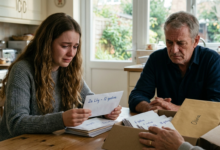

“I didn’t do anything wrong.”
Daniel gently took her hand.
“I know you didn’t.”
“Then why does Dad want the police to take you away?”
Daniel looked toward Eric.
For a moment, neither man spoke.
Then Daniel turned back to Sophie.
“Your dad was frightened because he loves you. But he was wrong to accuse me before knowing what happened.”
Sophie wiped her cheeks.
“Are you going away?”
“No, sweetheart. I’m right here.”
Eric stood against the wall.
His face had gone gray.
For the first time since arriving at the hospital, he looked as frightened as I felt.
But there was no time to confront him.
The neurosurgeon entered the room.
And the next words out of his mouth made every argument seem suddenly meaningless.
“We need to relieve the pressure on Sophie’s brain.”
The diagnosis nobody expected
The neurosurgeon, Dr. Harris, showed us the MRI images.
A mass was located deep inside Sophie’s brain, close to the pineal region.
It appeared to be interfering with the normal circulation of cerebrospinal fluid.
That explained her increasingly severe headaches, vomiting, and problems with balance and vision.
But there was another possibility the medical team needed to investigate.
Certain rare intracranial germ cell tumors can produce hCG, the same hormone detected by pregnancy tests.
Some can also cause hormonal changes that affect puberty.
Sophie’s early development and positive pregnancy tests could therefore be related to the mass.
“Are you saying my daughter has cancer?” I asked.
“We’re concerned that she may have a germ cell tumor,” Dr. Harris explained. “But we need further testing to establish exactly what we’re dealing with.”
I looked at Sophie.
She was watching a cartoon on the television, holding her stuffed rabbit against her chest.
Ten years old.
She still believed that sleeping with her rabbit would keep bad dreams away.
And now strangers were discussing surgery on her brain.
I couldn’t breathe.
Daniel quietly pulled a chair beside me.
Eric stood on my other side.
For once, neither man tried to speak for me.
I looked at Dr. Harris.
“What do we need to do?”
He explained the immediate plan.
The team needed to address the dangerous buildup of fluid and obtain the information necessary to guide treatment.
I listened carefully.
Asked questions.
Signed the appropriate consent forms.
And when the doctors came to take Sophie away, I kissed her forehead.
“Mommy?”
“Yes, baby?”
“Will you be here when I wake up?”
I held her hand.
“Right here.”
She looked at Daniel.
“And you?”
He leaned closer.
“Of course, bug.”
Then she looked at Eric.
He was crying.
“I’ll be here, too, sweetheart.”
Sophie nodded.
For the first time that day, she seemed a little less afraid.
The secret my daughter had been keeping
While Sophie underwent her procedure, Eric and Daniel sat at opposite ends of the waiting room.
I stayed between them.
Not because I wanted to keep the peace.
Because I couldn’t bear another argument.
After nearly an hour, Eric finally spoke.
“I thought I was protecting her.”
Daniel didn’t look up.
“You accused me of hurting a child.”
Eric swallowed.
“I saw the test result. I panicked.”
“You didn’t ask what happened. You didn’t wait for the doctors. You wanted someone arrested.”
Eric looked at me.
“I didn’t know what else to think.”
I took a slow breath.
“You were right to be worried about Sophie. We all were. But fear doesn’t give you permission to decide someone is guilty.”
He lowered his head.
Then he said something I hadn’t expected.
“Sophie told me about the headaches weeks ago.”
I turned toward him.
“What?”
“She mentioned them during one of our weekends together.”
My stomach tightened.
“What did she say?”
“She said her head hurt sometimes when she woke up. I told her she probably needed more sleep.”
I stared at him.
“Did she tell you about her vision?”
He hesitated.
“She said the television looked blurry once.”
I closed my eyes.
I had taken Sophie to her pediatrician because of the headaches.
But I hadn’t known about the worsening vision until that morning.
Eric had known something was changing.
And he hadn’t told me.
“Why didn’t you say anything?”
“I didn’t think it was serious.”
Daniel stood.
“She was having headaches and trouble seeing, and you never told Rachel?”
Eric looked ashamed.
“I thought she was just spending too much time on her tablet.”
I pressed my fingers against my temples.
There had been so many small signs.
The headaches.
The mornings she didn’t want breakfast.
The way she’d stopped reading in bed.
Each one had seemed manageable.
Until suddenly, they weren’t.
But blaming one another wasn’t going to help Sophie now.
I looked at both men.
“When she comes out of that procedure, she needs parents who can listen to each other.”
Neither argued.
The truth that cleared Daniel’s name
Two days later, Sophie’s doctors explained the findings from her surgery and further tests.
The results supported the diagnosis of an intracranial germ cell tumor that was producing hCG.
The mass was also responsible for the pressure buildup that had caused her neurological symptoms.
It was a frightening diagnosis.
But it finally explained the pregnancy test results.
There had been no pregnancy.
The medical team had also continued its safeguarding assessment, taking Sophie’s statements and the available evidence seriously.
Nothing uncovered during the evaluation supported Eric’s accusation against Daniel.
I stood outside Sophie’s room while the doctor explained the diagnosis to Eric.
He covered his mouth.
“Oh, God.”
Then he looked at Daniel.
For several seconds, he couldn’t speak.
Finally, he whispered:
“I accused you of something terrible.”
Daniel said nothing.
“I was wrong.”
“You were.”
Eric’s eyes filled.
“I’m sorry.”
Daniel looked through the window at Sophie.
“She heard you, Eric. She thought you were going to have me taken away while she was sick.”
“I know.”
“Then you need to apologize to her, too.”
Eric nodded.
But Daniel wasn’t finished.
“And you need to correct what you said to everyone you told. I don’t want Sophie hearing rumors about this when she goes back to school.”
Eric agreed.
He contacted the family members he’d called during his panic, acknowledged that his accusation had been unfounded, and asked them not to spread it further.
He also apologized to Sophie.
Not with excuses.
Not by telling her he had only been trying to protect her.
He sat beside her bed and said:
“Sweetheart, I was scared, and I said something about Daniel that wasn’t true. I’m sorry I frightened you.”
Sophie looked at him.
“Are you still mad at Daniel?”
Eric shook his head.
“No.”
She thought about that.
Then she reached for his hand.
“Good. Because I need both of you.”
Eric began crying again.
The fight we couldn’t have imagined
Sophie’s treatment didn’t end with the surgery.
Over the following months, she underwent specialist cancer treatment according to the plan developed by her pediatric oncology team.
There were difficult days.
Days when she was exhausted.
Days when she didn’t want to eat.
Days when she was angry that her friends were going to school while she was sitting in a hospital room.
Once, she threw her stuffed rabbit across the bed.
“I hate this!”
I picked it up.
“I know, sweetheart.”
“No, you don’t!”
She turned away from me.
I sat beside her.
After a while, she whispered:
“I’m sorry, Mommy.”
I shook my head.
“You don’t have to apologize for being angry.”
She started crying.
“I just want to be normal again.”
I held her close.
“I know.”
Daniel came to the hospital every evening he could.
He read to her.
Helped her with schoolwork.
And learned how to help care for her without making her feel like a patient every minute of the day.
Eric adjusted his work schedule so he could attend appointments and spend more time with her.
The two men still disagreed sometimes.
But when Sophie needed something, they learned to communicate.
Nobody was competing to be the better father anymore.
There was only one little girl who needed both of them.
The letter beneath her pillow
Four months after the diagnosis, Sophie’s follow-up scans showed that the tumor had responded to treatment.
Her doctors explained that she would still need ongoing care and surveillance.
But for the first time in months, we could discuss plans beyond the next appointment.
That evening, Sophie asked me to bring her backpack to the hospital.
I found a folded piece of paper tucked inside the front pocket.
It was labeled:
FOR DANIEL — DON’T READ, MOM!
I smiled.
“Someone has a secret letter.”
Sophie turned bright red.
“Mom!”
I handed it to her.
She looked at the envelope for a moment.
Then she said:
“Can you give it to Daniel when he gets here?”
“Of course.”
When Daniel arrived, she handed him the letter.
He opened it.
I watched his expression change as he read.
Then he sat down.
“Bug, can I hug you?”
She nodded.
He wrapped his arms around her.
And he started crying.
Later, when Sophie fell asleep, Daniel showed me the letter.
It was written in her uneven handwriting.
Dear Daniel,
When Dad told the police to arrest you, I was scared they would take you away.
I wanted to tell everyone you didn’t do anything, but my head hurt so much that I couldn’t think.
I was scared of being sick, but I was more scared that you wouldn’t be there when I woke up.
You always tell me that being brave doesn’t mean you’re not scared.
It means you do the right thing even when you are.
Thank you for staying.
Love, Sophie.
Daniel pressed the paper against his chest.
“She thought I was going to leave.”
I took his hand.
“But you didn’t.”
He looked through the window at our daughter.
“No.”
Then he folded the letter carefully and placed it in his wallet.
The day Sophie came home
Nearly a year after that terrifying afternoon in the emergency room, Sophie was back in school.
Her medical team continued to monitor her closely, and she still had follow-up appointments.
But she was feeling better.
Her headaches had improved.
She could read again without the letters blurring together.
And she had returned to arguing with me about bedtime.
I had never been so grateful to hear my daughter complain about brushing her teeth.
One Friday afternoon, her teacher invited us to a small classroom celebration.
The students had been asked to write about someone who made them feel safe.
Sophie wanted all three of us to attend.
So Eric, Daniel, and I sat together in the back row.
She walked to the front of the classroom carrying a sheet of paper.
She looked nervous.
Then she began reading.
“When I was ten, I went to the hospital because my head hurt.”
My throat tightened.
“The doctors found something in my brain. I had to have surgery, and I was really scared.”
She looked toward us.
“My mom held my hand when I was afraid.”
She smiled at Eric.
“My dad came to the hospital and stayed with me.”
Then she looked at Daniel.
“And my other dad promised he would be there when I woke up.”
Daniel lowered his head.
Sophie continued.
“Sometimes grown-ups make mistakes. Sometimes they get scared and say things they shouldn’t.”
She paused.
“But when I was sick, I learned that my family doesn’t have to be perfect to love me.”
Then she lifted her paper.
At the bottom was a drawing.
A little girl standing between two men, with a woman holding her hand.
Above them, she’d written:
MY FAMILY IS BIG ENOUGH FOR ALL THE PEOPLE WHO LOVE ME.
I started crying.
Eric quietly reached for a tissue and handed it to Daniel.
And for the first time, the two men smiled at each other.
The beautiful truth
That evening, Sophie fell asleep on the couch with her stuffed rabbit tucked beneath her arm.
Daniel covered her with a blanket.
Eric had already gone home after giving her a goodnight hug.
I stood beside the living room window, thinking about the day everything had begun.
One positive pregnancy test.
One terrible accusation.
One frightened little girl.
And a diagnosis none of us could have imagined.
For months, I had replayed that afternoon, wondering what might have happened if we’d delayed taking Sophie to the hospital.
But I no longer wanted to spend my life trapped inside the possibilities.
We had listened when she told us something was wrong.
We had sought medical care.
And when the truth finally emerged, we had chosen to face it together.
Daniel came to stand beside me.
“She’s going to be okay tonight,” he whispered.
I nodded.
“She is.”
From the couch, Sophie suddenly stirred.
“Mom?”
I walked over.
“Yes, sweetheart?”
She opened one sleepy eye.
“Is Daniel still here?”
I smiled.
“Right here, bug.”
She reached out for his hand.
Then she reached for mine.
And with one of us on either side of her, she closed her eyes again.
I looked at the little girl who had survived so much.
The child whose medical test had nearly torn our family apart.
And I finally understood something.
The most important result we received that day wasn’t the one that frightened us. It was the one that helped the doctors discover what was making our daughter sick.
The test that had seemed to announce an impossible pregnancy had instead helped uncover a condition that needed urgent treatment.
It hadn’t told us who to blame.
It had told us that Sophie needed help.
I kissed her forehead.
“Goodnight, sweetheart.”
And for the first time in a very long time, I went to bed without listening for the sound of my daughter’s footsteps in the hallway.
She was sleeping peacefully.
Her stuffed rabbit was beside her.
And everyone she loved knew exactly where they belonged.