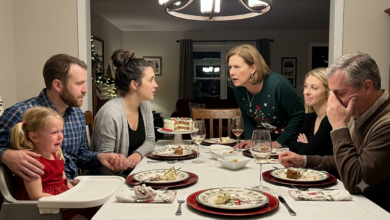
MY PARENTS CHARGED $99,000 TO MY AMEX FOR MY SISTER’S HAWAII TRIP—THEN MOM CALLED ME LAUGHING
PART 3
The man standing at my parents’ front door was not a debt collector.
He was an investigator.
Behind him stood another officer holding a folder.




My father stared at them.
“Can I help you?”
The investigator asked for my mother by name.
Mom came into the hallway still wearing the linen outfit she had flown home in.
Her tan was fresh.
Her smile wasn’t.
“What is this?”
The investigator identified himself and explained that they were following up on a fraud complaint involving unauthorized financial activity.
Mom looked at Dad.
Then she laughed.
Actually laughed.
“This is ridiculous. Our daughter is having a tantrum.”
The officer didn’t react.
“We need to ask you some questions.”
Dad stepped forward.
“This is a private family matter.”
“No, sir,” the investigator said. “It isn’t.”
That sentence traveled through our family faster than any rumor ever had.
By the next morning, my phone was filled with messages.
Aunts.
Cousins.
An uncle I had not spoken to in three years.
Most of them said some version of the same thing.
How could you do this to your own parents?
Nobody asked how my parents could charge $99,000 to my card.
That told me everything.
I didn’t argue.
I forwarded every message to my attorney and stopped responding.
Three days later, investigators asked me to come in.
They had found more.
A lot more.
The Hawaii trip was only the newest offense.
There was an old department-store account opened when I was twenty-two.
A medical payment plan.
A utilities account.
A small personal loan.
And a car-insurance policy where my name had been used as the financially responsible party.
Some I knew about.
Others I didn’t.
“What does this mean?” I asked.
My attorney, Rachel, sat beside me.
“It means this may be a pattern.”
My throat tightened.
All those years, I had thought I was unlucky.
Careless.
Bad with paperwork.
Every surprise notice had made me feel ashamed.
Now, looking at the evidence spread across the conference table, I realized something devastating.
I had spent years cleaning up crimes committed against me.
Rachel slid one document closer.
“This one is especially important.”
It was the authorization form for the Hawaii booking.
The travel company had required additional verification because of the unusually high total.
Someone had signed my name.
The signature looked like mine at first glance.
But it wasn’t.
Underneath it was a second notation.
Verified by M. Carter.
My mother.
She had effectively confirmed her own forged authorization.
I stared at the page.
“That’s her handwriting.”
Rachel nodded.
“We know.”
Then came the voicemail.
My mother’s voice.
Bright.
Mocking.
Confident.
We know your birthday. We know your Social Security number. We raised you.
She had said it like proof of ownership.
Investigators heard it differently.
Evidence.
Madison returned from Hawaii two days after my parents.
Her first call to me lasted eleven seconds.
“You ruined everything.”
I nearly laughed.
“I ruined it?”
“My cards don’t work.”
“They were connected to fraudulent charges.”
“You could have handled this privately.”
“I tried privately for ten years.”
Silence.
Then she said something that finally destroyed the last illusion I had about her.
“You have more money than we do.”
I closed my eyes.
“That doesn’t make it yours.”
“You’re so selfish.”
“No, Madison.”
My voice stayed calm.
“I just finally stopped letting you confuse access with entitlement.”
She hung up.
A month later, the family gathered at my aunt’s house without inviting me.
I knew because three people texted me afterward.
Apparently my mother cried for two hours.
She told everyone I was vindictive.
That I cared more about money than family.
That Madison’s once-in-a-lifetime trip had been “ruined.”
Then my eighty-year-old grandmother asked one question.
“Did you take the girl’s money without permission?”
Mom tried to explain.
Grandma asked again.
“Yes or no?”
Eventually Mom admitted it.
Grandma stood up.
“So she didn’t destroy this family.”
Then she looked around the room.
“You people just finally ran out of ways to make her pay for it.”
Nobody had an answer.
Neither did I when Grandma called and told me.
I cried after we hung up.
Not because I wanted revenge.
Because for the first time in years, someone had said the truth out loud.
The legal process took months.
Some charges were reversed.
Others required documentation and investigation.
My credit was locked down.
Passwords were changed.
Security questions were replaced with answers my family couldn’t guess.
I froze my credit with the bureaus.
Closed old accounts.
Removed every shared financial connection I could find.
My parents faced consequences for the fraudulent activity.
I won’t pretend they were dragged away dramatically while dramatic music played.
Real consequences are slower than that.
Interviews.
Court dates.
Legal bills.
Repayment obligations.
Formal records.
My father became quieter.
My mother became angrier.
Madison spent months insisting she was “just the beneficiary” and knew nothing about how the charges were made.
Maybe part of that was true.
But she had known enough to post champagne photos while my mother mocked me over the phone.
That was enough for me to stop pretending she was innocent.
Six months later, Mom mailed me a letter.
Not an apology.
A four-page explanation.
She said she had always believed successful children were supposed to help the family.
She said Madison needed confidence.
She said I had always been “more capable.”
That sentence stayed with me.
More capable.
That was the role they had given me as a child.
Madison got comfort.
I got responsibility.
She was protected because she was fragile.
I was exploited because I was strong.
I wrote one sentence back.
Being capable does not mean being available for abuse.
Then I stopped.
No essay.
No argument.
No begging her to understand.
For once, understanding was not my job.
A year after the Hawaii trip, I took my own vacation.
Nothing extravagant.
Four days on the Oregon coast.
A quiet hotel.
A gray beach.
A balcony with a view of the water.
The first morning, I sat outside drinking coffee while waves rolled across the sand.
My phone was silent.
No emergency from Dad.
No crisis from Mom.
No request from Madison.
No account alert.
No fraud notice.
Just quiet.
I thought about the $99,000.
For months, that number had felt monstrous.
A symbol of how little my family respected me.
But sitting there, I realized the money had uncovered something more valuable than it had taken.
The truth.
They had believed love meant access.
Access to my money.
My identity.
My time.
My forgiveness.
They were wrong.
Love requires permission.
Respect.
Limits.
And the freedom to say no without being punished for it.
My mother once called me worthless because she thought she had emptied my account.
But that was the last great mistake she made about me.
She believed my value lived in what she could take.
It didn’t.
And the moment I understood that, I stopped being the family bank, the family repair kit, and the daughter who survived by making everyone else comfortable.
I finally became something much simpler.
My own person.
And for the first time in thirty-one years, that was more than enough.