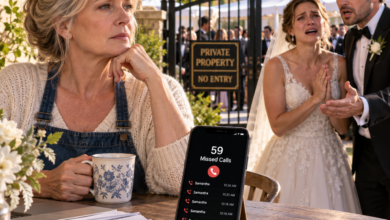
My Mother-in-Law Threw Away the Basket My Father Brought From Teruel—Then She Claimed My Apartment Was Really Hers
PART 3 — THE FULL ENDING
Álvaro arrived forty-three minutes later.
He didn’t knock.
He entered the old code twice.




When it failed, he started pounding on the door.
“Clara!”
My father looked at me.
“Do you want me to leave?”
“No.”
That answer came easily.
For years, my father had made himself smaller whenever he believed he might embarrass me.
Not this time.
I opened the door but kept the security chain engaged.
Álvaro stood outside beside Mercedes.
He held a brown document envelope.
“Open the door.”
“No.”
His jaw tightened.
“My mother lives here.”
“She did.”
“Clara, stop acting insane.”
My father moved into view behind me.
Álvaro’s expression changed.
“Of course he’s still here.”
That sentence told me everything about whose side he had already chosen.
“What’s in the envelope?” I asked.
His anger vanished.
A strange smile appeared.
“Proof.”
“Of what?”
“That you don’t get to throw my mother out of our home.”
“My home.”
“Our home.”
“I bought it two years before we married.”
He lifted the envelope.
“Things changed.”
My stomach tightened.
I removed the chain.
Not because I trusted him.
Because I wanted to see the papers.
He entered.
Mercedes followed, suddenly calm.
That scared me more than the shouting had.
Álvaro spread several documents across the dining table.
“Read.”
The first appeared to be a private ownership agreement.
It claimed I had transferred fifty percent of the apartment to Álvaro as security for a marital loan.
The second referenced money supposedly borrowed from Mercedes.
The third carried what looked like my signature.
For several seconds, I genuinely questioned my memory.
Then my father leaned closer.
“Clara.”
“What?”
He pointed at the date.
“Where were you that day?”
March 12.
I stared.
Then I remembered.
Paris.
I had been attending my company’s annual financial summit.
I had flown out on March 10 and returned on March 14.
The supposed document had been signed before a Madrid notary on March 12.
I looked at Álvaro.
His face changed before he could control it.
“I was in France.”
“So?”
“This says I appeared in person in Madrid.”
Mercedes interrupted.
“Perhaps you don’t remember.”
I almost laughed.
“I gave a presentation to three hundred executives that morning.”
Álvaro reached for the documents.
I put my hand over them.
“Don’t.”
“Clara.”
“Don’t touch them.”
My father quietly took out his phone.
“What are you doing?” Mercedes snapped.
“Taking photographs.”
She lunged toward the table.
That was the first moment she looked afraid.
And it told me the documents mattered.
I photographed every page.
Then I called my attorney.
Álvaro laughed.
“You’re seriously doing this?”
“Yes.”
“You’re going to destroy our marriage over an argument between our mothers?”
I stared at him.
“My mother is dead.”
He blinked.
“You know what I mean.”
“No. I know exactly what this is about.”
I pointed toward the kitchen.
“My father brought food.”
“Clara—”
“Your mother threw it in the garbage because she thinks being rural means being dirty.”
Mercedes scoffed.
“Don’t make this sentimental.”
I turned to her.
“You’re right.”
Her smile returned.
“This is no longer sentimental.”
I tapped the forged document.
“This is criminal.”
Silence.
Álvaro’s face hardened.
“You always do this.”
“Do what?”
“Act like you’re better than us because you earn more.”
My father shifted beside me.
I said nothing.
Álvaro continued.
“You buy the apartment. You pay the bills. You make every decision. You’ve spent four years making me feel like a guest.”
That shocked me.
“Then why did you stop contributing?”
His mouth closed.
I looked at Mercedes.
Then back at him.
“How long?”
Neither answered.
“How long have you been planning this?”
Mercedes folded her arms.
“You married a man, Clara. You didn’t hire an employee.”
That was when my phone rang.
My attorney.
I stepped into the hallway to speak privately.
She asked me to send photographs immediately.
Ten minutes later, she called back.
Her first sentence changed everything.
“Clara, these papers are not only suspicious. The notary stamp appears invalid.”
My skin went cold.
“What does that mean?”
“It may be fabricated.”
I looked through the glass door toward Álvaro.
He was whispering to his mother.
My attorney continued.
“And there’s something else. I pulled a preliminary property registry report. You are still the sole registered owner.”
Relief hit first.
Then anger.
“Can they claim a marital interest?”
“Not based on these documents. But don’t confront them alone about the possible forgery. Save everything.”
I ended the call.
When I returned, Mercedes was smiling.
“Well?”
I looked at her.
“The apartment is still legally mine.”
Her smile disappeared.
Álvaro stood.
“That doesn’t mean anything.”
“It means enough.”
Then my father said something unexpected.
“Ask them about the fifty-eight thousand euros.”
Everyone froze.
I turned.
“What?”
My father looked at Álvaro.
Then at Mercedes.
“I heard her mention it six months ago.”
Mercedes went white.
My father explained.
During a previous visit, he had woken early and gone into the kitchen for water.
Mercedes was on the phone.
She thought everyone was sleeping.
“She said something about needing fifty-eight thousand before the end of the year,” he told me. “And that once Álvaro had a claim on the apartment, the bank would stop asking questions.”
I looked at my husband.
“What fifty-eight thousand?”
He said nothing.
That was the answer.
Over the next two weeks, everything unraveled.
My accountant helped me review our finances.
The additional card Mercedes had used was only the beginning.
Álvaro had taken out personal loans.
He had hidden credit-card debt.
He had transferred money to his mother in small amounts to avoid drawing attention.
And Mercedes had lost tens of thousands of euros in what she described as an “investment opportunity” promoted by a man she met through friends.
They were drowning.
The apartment was their lifeboat.
Not metaphorically.
Literally.
They intended to create enough paperwork to pressure me into recognizing Álvaro’s interest in the property.
Then they planned to use that supposed interest as leverage for refinancing.
The marriage ended quickly after that.
The investigation did not.
The forged documents were reported.
The fake stamp became the most serious part.
The man who prepared them turned out not to be a notary at all, but an acquaintance of Mercedes who had previously worked in property administration.
Once questioned, he cooperated.
Mercedes’s version collapsed.
So did Álvaro’s.
For months, I felt embarrassed.
Not because I had lost the marriage.
Because I kept replaying obvious signs.
The unexplained transfers.
The defensive answers.
The way Álvaro always called my apartment “ours” when asking for money but “yours” when something needed fixing.
One evening, I said to my father:
“How did I not see it?”
We were sitting in my kitchen.
He had brought another basket.
This time, I had placed everything on the table myself.
He broke off a piece of bread.
“Because you loved him.”
“That’s not an excuse.”
“No.”
He chewed thoughtfully.
“But it is an explanation.”
I looked at his hands.
Cracked skin.
Old scars.
Fingers bent slightly from decades of work.
Then something occurred to me.
“You knew something was wrong before that day, didn’t you?”
He became quiet.
“Dad.”
Finally, he nodded.
Years earlier, when I bought the apartment, my father had insisted I purchase it entirely in my own name.
At the time, I found it old-fashioned.
I had been dating Álvaro seriously.
I planned to marry him.
My father had said only:
“What you build before marriage should remain clearly yours unless you freely decide otherwise.”
I thought he didn’t trust Álvaro.
The truth was different.
My father had seen my mother struggle financially after a relative convinced her to co-sign a debt when they were young.
He had spent years paying off the consequences.
“I wasn’t protecting you from Álvaro,” he said.
“I didn’t know him well enough to judge him.”
“Then what were you protecting me from?”
He smiled sadly.
“From ever needing permission to leave someone.”
I stopped breathing for a second.
That was the final gift I had never understood.
Selling part of his land had helped me earn my degree.
Years of hard work had helped me begin my career.
But insisting that I keep legal ownership of my first home?
That had given me an exit I never knew I would need.
Months later, my divorce was finalized.
Mercedes moved back into her own apartment after the renovation she had claimed would take a few months.
Fourteen months had somehow ended very quickly once my credit card disappeared.
Álvaro tried to apologize.
I listened once.
Then I told him something I had learned from my father.
“An apology is not a key.”
He looked confused.
“It doesn’t automatically let you back into the place you damaged.”
That was our last conversation.
The following spring, I drove to Teruel.
My father and I spent three days together.
He showed me the olive trees.
The cooperative where he bought the cheese.
The bakery whose flour dust Mercedes had once treated like contamination.
Before I left, he handed me another wicker basket.
I laughed.
“Dad, I have food in Madrid.”
“I know.”
“What’s this one for?”
He shrugged.
“So your house smells like home.”
When I returned to Pozuelo, I placed that basket on the kitchen counter.
Exactly where Mercedes had thrown the first one away.
I didn’t clean the dust from the bottom.
I left it there for a while.
Not because dirt had suddenly become sacred.
But because I finally understood what she had mistaken for dirt.
It was evidence of work.
Of land.
Of sacrifice.
Of a man who had spent his life giving me things without ever making me feel indebted.
And that apartment?
Mercedes had been wrong.
It wasn’t really mine because my name was on a registry.
It was mine because my father had quietly helped me build a life in which no one could take away my freedom.
That was worth far more than the apartment itself.